
From NLHA:
On September 10, HUD’s Office of Multifamily Housing issued Notice H 2026-06, which strikes Section 100–2.20 of the Minimum Property Standards for Housing (Handbook 4910.1) and makes emergency call systems an optional technology at certain elderly multifamily properties. NLHA has urged HUD for several years to clarify and modernize this outdated standard, and we appreciate the Department’s revised guidance.
The notice applies to elderly properties with 20 or more units subject to HUD’s minimum property standards under 24 CFR part 200, subpart S, and to Section 202 projects subject to 24 CFR 891.120. Minimum property standards do not apply to uninsured properties with Section 8 HAP contracts unless those are Section 202/8 contracts. Owners whose emergency call system requirement arises from a separate HUD business agreement (a grant agreement or contract, for example) may request an amendment to strike the requirement consistent with the revised policy.
Additionally, the Notice includes the following provisions:
– Operable systems may remain in service. An owner who chooses to remove an operable system must notify tenants in advance and consider the comments received.
– Inoperable pull-cord and other nonfunctioning systems must be removed.
– Any system that remains available to residents is still evaluated under the NSPIRE call-for-aid standard.
-Where no functioning system is in place, HUD encourages regular welfare checks, particularly for residents living alone or with limited mobility.
Before removing equipment, owners should confirm that no other obligation applies, such as state or local code, licensing requirements, accessibility standards, financing documents, or insurance requirements that impose separate duties.
The full notice is available at https://lnkd.in/e7Pt2mgS. HUD directs questions to AssetManagementPolicy@hud.gov. As always, please feel free to reach out to the NLHA team with any questions.
National Housing Compliance Acquires The REAC Company
TUCKER, Ga. — National Housing Compliance (NHC), a national leader in affordable housing compliance, professional training, consulting services, and Performance-Based Contract Administration (PBCA) for the U.S. Department of Housing and Urban Development (HUD) in Georgia and Illinois, announces the acquisition of The REAC Company, marking the first acquisition in the organization’s 25-year history.
The acquisition represents a significant milestone in NHC’s long-term growth strategy and expands the organization’s ability to serve affordable housing owners and agents through a broader portfolio of property services.
The transaction also marks the launch of NHC Property Services, a new division created to provide comprehensive property support services to affordable housing communities nationwide. During the transition, The REAC Company will continue to operate under its established brand, The REAC Company: an Affiliate of NHC Property Services, before ultimately transitioning to the NHC Property Services brand.
For more than two decades, National Housing Compliance has earned the trust of affordable housing providers by delivering HUD contract administration, regulatory compliance, consulting, and technical assistance. With the addition of The REAC Company, NHC now extends its expertise beyond compliance by offering the operational services communities need to maintain high-quality housing and meet evolving inspection standards.
The expanded service platform includes:
· NSPIRE inspection preparation and repair services
· Unit turnover
· Temporary maintenance staffing
· Capital improvement services
· Property maintenance support
· Post-inspection corrective actions
Together, National Housing Compliance and NHC Property Services now provide one of the industry’s most comprehensive solutions—combining regulatory expertise with practical, on-site execution to help affordable housing providers improve operations, protect their investments, and deliver quality housing for residents.
“As the affordable housing industry continues to evolve, our responsibility is to evolve with it,” said Karen Romaine Thomas, Chief Executive Officer of National Housing Compliance. “For more than 25 years, we have helped owners and agents successfully navigate complex regulatory requirements. The launch of NHC Property Services represents the next chapter in that mission. We can now provide not only the compliance expertise our clients have trusted for decades, but also the operational support they need to strengthen their communities. This acquisition reflects our continued investment in the affordable housing industry and our commitment to helping our clients succeed.”
Affordable housing providers today face increasing regulatory requirements, changing inspection standards, aging housing stock, workforce shortages, and growing operational demands. By combining compliance expertise with experienced property services, NHC offers a single, trusted partner capable of supporting owners and agents from planning and preparation through project completion.
“We’ve built our reputation by helping affordable housing communities respond quickly and effectively to inspection and maintenance challenges,” said Ben Kinney, President of The REAC Company. “Joining National Housing Compliance allows us to expand that mission while providing our clients access to additional resources, expertise, and services. We’re excited to be part of an organization that shares our commitment to serving the affordable housing industry.”
NHC Property Services will continue serving affordable housing communities nationwide while expanding its capabilities and geographic reach. Existing clients of both organizations will continue receiving the high level of service they have come to expect, now backed by a broader range of integrated solutions.
This acquisition reflects National Housing Compliance’s ongoing commitment to innovation, strategic growth, and the delivery of exceptional value to the affordable housing industry.
For more information, visit www.nhcinc.org or www.thereaccompany.com.
ROAD to Housing Act Becomes Law
The 21st Century ROAD to Housing Act became law at midnight on Saturday, July 11, in a significant win for the housing community. NLHA joined eight housing groups representing thousands of housing providers and millions of residents to congratulate the Members of Congress and the President for the passage and enactment of the amended 21st Century ROAD to Housing Act.
NLHA COO/Executive Director Denise Muha said, “NLHA applauds all partners as well as lawmakers in both parties who diligently worked together in commitment to finding real solutions to address the national priority of housing affordability by spurring production and preservation.”
Notable provisions in the amended 21st Century ROAD to Housing Act include:
· Increasing bank public welfare investments from 15% to 20% (Section 203).
· Allowing Community Development Block Grant (CDBG) funding for the construction of new affordable housing (Section 204).
· Streamlining the National Environmental Policy Act (NEPA) review process (Section 206).
· Increasing FHA-insured multifamily loan limits (Section 211).
· Lifting the Rental Assistance Demonstration (RAD) program cap by 100,000 units and extending protections for tenants in RAD buildings (Section 212).
· Eliminating the permanent chassis requirement for manufactured homes (Section 310).
· Reducing delays in HUD inspections by allowing Low-Income Housing Tax Credit (LIHTC), HOME Investment Partnerships (HOME) program, and USDA Rural Housing Service units to automatically meet Housing Choice Voucher (HCV) inspection requirements if they have passed an inspection within the past year (Section 405).
· Reauthorizing the HOME program (Section 501).
· Authorizing the Community Development Block Grant Disaster Recovery (CDBG-DR) program for three years (Section 504).
· Authorizing a new Moving to Work (MTW) program cohort (Section 505).
· Restricting the purchase of new single-family homes by large institutional investors; providing exemptions, including for large institutional investors seeking to purchase or build new single-family homes specifically for the rental market, and establishing an outreach resource for renters of homes owned by large institutional investors through landlord disputes (Section 1001).
NLHA looks forward to continuing to work with its members, industry partners and policymakers on implementing solutions to build and preserve housing nationwide.
Maintain and active UEI number
| Owners/Agents, HUD requires all Section 8 property owners to maintain an active Unique Entity Identifier (UEI). Keeping your UEI current ensures uninterrupted compliance and will prevent delays or complications when there are changes to your contract, such as a transfer, assignment, or early renewal. An active UEI is also required to maintain access to HUD systems and to receive timely Housing Assistance Payments (HAP). As instructed by HUD, if your UEI becomes inactive, NHC will place your voucher payments on hold until we receive confirmation of an active UEI. As your PBCA, we will send a reminder email 15 days before your UEI expiration date. However, it is the Owner/Agent’s responsibility to renew the UEI through HUD’s SAM.gov website. To renew, simply log into your SAM.gov account and complete the renewal process. Once your UEI has been renewed, please email your UEI number and updated expiration date to NHC at OwnerAgentInformation@nhcinc.org or have your NHC Portal Administrator update the UEI number and expiration date in your account. This ensures there will be no interruption in service or payments. If you have questions or would like more information about HUD’s UEI requirements, please refer to HUD Notice H 2012-06 and the reinforcing language in Notice H 2023-01, Section V. NHC is here to support our Owners/Agents and help make this process as smooth and straightforward as possible. If you have any additional questions, please don’t hesitate to reach out to OwnerAgentInformation@nhcinc.org. |
EIV Citizenship Verification Tool
From the Office of Multifamily Housing Programs:
Dear Owners/Agents:
Please note that the below communication requires Owners/Agents to act on information in HUD’s Enterprise Income Verification (EIV) system within 30 calendar days of today’s date.
In a letter sent to Owners/Agents on January 12, 2026, the Department reminded you of your legal obligation to ensure that Section 8 Project-Based Rental Assistance (PBRA) is provided only to U.S. citizens and noncitizens who have eligible immigration status[1]. That letter also reaffirmed the procedures you must take to verify PBRA applicant citizenship/eligible immigration status and how to calculate prorated assistance for mixed-status families[2].
Today, HUD’s Office of Multifamily Housing Programs released a new EIV project-level report for Owners/Agents to assist in identifying potential tenant eligibility discrepancies using available federal citizenship and immigration information.
EIV-SAVE Tenant Matching Report
The EIV-SAVE Tenant Matching Report is a point in time report which cross-references HUD-50059 tenant data submitted to HUD’s Tenant Rental Assistance Certification System (TRACS) with information in U.S. Citizenship and Immigration Services (USCIS)’s Systematic Alien Verification for Entitlements (SAVE) system[3] to produce an initial verification response[4].
This report is designed to include tenants who have a potential discrepancy between their citizenship/eligible immigration status listed in TRACS and the information in SAVE. The Owner/Agent must review these discrepancies and ensure tenant eligibility in accordance with Attachment A.
At the time of this communication, the EIV-SAVE Tenant Matching Report is a one-time report. In its current state, a tenant will not actually be removed from the report until HUD publishes an updated report. In the future, HUD may provide an updated report on a routine basis.
To access this report in EIV and review a sample of the EIV-SAVE Tenant Matching Report (including an explanation of the report’s data fields), please refer to the instructions outlined in Attachment A.
Owners/Agents can only access EIV-SAVE Tenant Matching Reports for their assigned projects and must have access to EIV to review the report. Please email MFH_EIV@hud.gov for assistance with EIV access and EIV project assignments.
References:
[1] Section 214 of the Housing and Community Development Act of 1980 and Executive Order 14218, Ending Taxpayer Subsidization of Open Borders.
[2] Mixed family, as defined in 24 CFR § 5.504, means a family whose members include those with citizenship or eligible immigration status, and those without citizenship or eligible immigration status.
[3] SAVE is an online information service that provides point in time immigration status and U.S. citizenship information to federal, state, local, territorial, and tribal agencies.
[4] Initial verification is the first step in determining an individual’s eligibility for federal benefits. Initial verification electronically compares the information from HUD against immigration records available to the Department of Homeland Security and returns a response within seconds.
Required Owner/Agent Actions within the Next 30 Days
Within the next 30 calendar days, Owners/Agents must access the EIV-SAVE Tenant Matching Report in EIV for each project with an identified discrepancy and resolve all discrepancies by performing the step-by-step actions described in Attachment B. Please thoroughly review attachments A and B prior to taking any action. Please note, not all projects have tenant discrepancies, so some Owners/Agents will find that they have no reports to review or that they have fewer reports to review than the number of projects that they own/manage. If a project does not have a report, then there are no discrepancies for the Owner/Agent to resolve.
This action will verify 1) that tenant data submissions to TRACS are error free and 2) that Owners/Agents obtained the required citizenship/eligible immigration documentation for all tenants in accordance with HUD’s regulations in 24 CFR Part 5, Subpart E. The Department believes that many of the discrepancies noted on the report can be resolved by correcting data entry errors in HUD-50059 submissions, but others will require more in-depth investigation.
Importantly, a tenant’s inclusion in the report does not definitively mean that they are ineligible for assistance. Owners/Agents may not deny or end an individual’s assistance based on discrepancies noted in the report that require further action or resubmission to SAVE. If an Owner/Agent determines that a tenant is ineligible for assistance after following all required steps in Attachment B, they must allow for an appeal and informal hearing per 24 CFR § 5.514 before terminating or prorating the tenant’s assistance.
If a tenant believes that their record at a federal agency contains errors or needs to be updated, the individual must contact the agency that maintains the record, such as the Social Security Administration or U.S. Citizenship and Immigration Services. It is important to note that SAVE is a database tool and it cannot correct source records.
Please note that tenants classified as ineligible noncitizens in TRACS are not currently assisted under PBRA and are excluded from the EIV-SAVE Tenant Matching Report.
HUD recommends that owners/agents use all available resources to learn more about SAVE and its capabilities, including the following webpages:
- https://www.uscis.gov/save
- SAVE Records Fast Facts for Benefit Applicant (provides more information on records updates and corrections).
- SAVE Tutorial: Introduction to SAVE and the Verification Process for SAVE Users
- SAVE Guidance
Owner/Agent Compliance
Owners/Agents should complete the steps in Attachment B for each tenant with an identified discrepancy. Aside from submitting corrected HUD-50059s and adjustments to Housing Assistance Payment (HAP) vouchers when appropriate, Owners/Agents do not need to submit additional follow up information. HUD will monitor EIV-SAVE Tenant Matching Report usage and may request information from an Owner/Agent as necessary.
Failure to perform the steps outlined in this letter may result in EIV penalties per Handbook 4350.1, REV-1, Ch. 9-19 and/or Active Partners Participation System (APPS) compliance flags for the Owner/Agent.
We sincerely appreciate your ongoing collaboration and commitment to ensuring that HUD assistance is provided only to eligible individuals and families. Please direct your EIV and SAVE questions to the following email boxes:
- EIV-SAVE Tenant Matching Report: MFH_SAVE@hud.gov
- EIV access and project assignments: MFH_EIV@hud.gov
- SAVE registration: MFH_SAVE@hud.gov
- SAVE password reset: https://secure.login.gov/
Please do not email USCIS with requests for account registration or password updates. USCIS does not manage HUD SAVE accounts.
References:
See Housing Notice 2016-15: Processing Guide for Previous Participation Reviews of Prospective Multifamily Housing and Healthcare Programs’ Participants
Attachment A: How to Navigate the EIV-SAVE Tenant Matching Report
Select USCIS-SAVE System under External Links on the EIV home page:
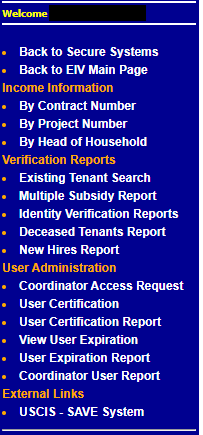
Note: This link previously redirected users to SAVE; this link now directs users to the EIV-SAVE Tenant Matching Report.
Click on the drop-down menus to select either a Contract Number or a Project Number. Please note, your drop-down list will only contain properties you manage in EIV that have one or more tenants identified with discrepancies. If a project does not show up on the list, it does not have any identified discrepancies.
Next, click Get Report.
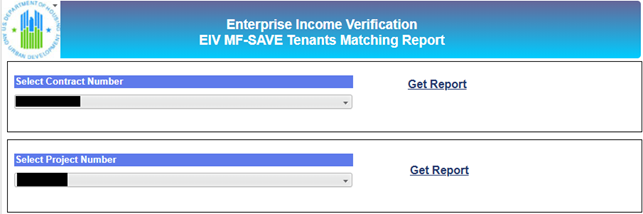
Below is a sample MF EIV-SAVE Tenant Matching Report for an individual project. Please note, the report will only contain tenants with identified discrepancies. Many impacted contracts will have a small number of tenants (five or less). The date in the top right corner of the page is the date that the TRACS data was cross-referenced with SAVE information.
Select Back to EIV MF-SAVE Navigation to get back to the main page. From here, owners/agents can select a different Contract Number or Project Number to review.

Explanation of Data Fields:
Contract Number: A project’s unique 11-character number assigned by HUD for the purpose of identifying the project’s rental assistance contract.
Project Number: A project’s unique 8-character number assigned by HUD for the purpose of identifying the project’s loan.
Property ID: The property’s unique 9-digit ID assigned by HUD in its portfolio database, the integrated Real Estate Management System (iREMS).
Head of Household SSN: The last 4 digits of the head of household’s Social Security Number.
Effective Date: Theeffective date of the income recertification (HUD-50059) from which tenant data was cross-referenced with SAVE information.
Subsidy Type Code: The subsidy type code entered into the family’s HUD-50059. For example, H1= Section 8; H4 = 236.
Member SSN: The last 4 digits of the family member’s Social Security Number whose TRACS data is potentially discrepant with their information in SAVE.
First Name: The family member with the potential discrepancy’s first name.
Last Name: The family member with the potential discrepancy’s last name.
Unit Address: The family’s unit address in the project. This information will populate from the form HUD-50059 if it was entered by the owner/agent.
USCIS Response: The initial verification response returned for the family member by SAVE.
Attachment B: Step-by-Step Instructions to Resolve Discrepancies in the EIV-SAVE Tenant Matching Report
Note: Owners/Agents must ensure they have both EIV and SAVE access before completing the following steps. Certain SAVE resources can only be accessed when a user is logged in.
Step 1: Log in to SAVE and navigate to Help>Resources to find the Guide to Understanding SAVE Verification Responses. Locate the “Initial Verification Responses” section of the Guide to assist with interpreting the USCIS Responses listed in the EIV report.
Step 2: Log in to EIV and navigate to the USCIS-SAVE System report under “External Links”. Select a contract or project number to review. Note: Only properties with tenant discrepancies will have reports available to review.
Step 3: Find the USCIS Response (last column of the report) for each tenant listed in the project’s report. If the tenant is no longer receiving assistance or no longer lives at the property, then no further action is necessary.
Step 4: Confirm that the tenant’s file contains acceptable evidence of eligible immigration status required by 24 CFR § 5.508 and prior SAVE verification results (including Class of Admission (COA)[1]) if applicable. See the table below for a description of acceptable evidence based on an individual’s citizenship or immigration status.
If acceptable evidence does not exist in the tenant file, then the owner/agent must obtain the required evidence and verify the tenant’s eligible immigration status per 24 CFR § 5.512.
References:
[1] COA refers to a specified single category of admission to a lawful immigration status
| Citizenship/Immigration Status | Required Evidence of Citizenship or Eligible Immigration Status |
| U.S. citizens or U.S. nationals | Signed declaration of U.S. citizenship or U.S. nationalityOwners may require applicants/residents to provide verification of citizenship |
| Noncitizens who are 62 or older at the time of admission | Signed declaration of eligible immigration statusProof of age document |
| All other noncitizens | Signed declaration of eligible immigration statusAn original document designated by DHS as acceptable evidence of immigration status in one of the six categories in § 5.506(a) for the specific immigration status claimed by the individualVerification consent form |
| Individuals who do not contend immigration statusNote: These individuals will not be listed in the EIV-SAVE Tenant Matching Report | The family must identify in writing to the owner/agent the family member (or members) who do not contend that they have eligible immigration status. |
Step 5: Verify that the tenant’s biographic information in Section C. Household Information of the HUD-50059 (e.g., name, date of birth, relationship code, citizenship status, Social Security Number, alien registration number, etc.) is correct based on tenant file documents. Owners/agents must immediately correct any data entry errors by transmitting a corrected HUD-50059 to TRACS.
Note: Do not use dashes when entering an individual’s alien registration number into the HUD-50059. For example, if an alien registration number is A-123-456-789, enter the alphanumeric number as A123456789.
Step 6: If steps 4 and 5 do not resolve the discrepancy between the information for a tenant listed in the EIV-SAVE Tenant Matching Report and the acceptable evidence of eligible immigration status provided by the tenant, then the Owner/Agent may create a new SAVE case using a full nine-digit Social Security Number (SSN) and/or immigration enumerator (such as an A-Number/USCIS Number, Arrival-Departure Record I-94 Number, SEVIS ID Number, Naturalization/Citizenship Certificate Number, or Visa Number) to determine the tenant’s citizenship/eligible immigration status. If the Owner/Agent determines that the tenant does not have citizenship or eligible immigration status based on the previous steps, the owner/agent must follow HUD’s regulations at 24 CFR § 5.514 prior to reducing or terminating a family’s assistance, after obtaining a signed verification consent form from the tenant, or an adult residing in the unit if the tenant is a child.
Step 7: Retain the EIV-SAVE Tenant Matching Report in both the project’s EIV Master File and in the tenant file, along with notes on actions taken to resolve the discrepancy.
HUD Announced Income Limits
On November 26, 2025, the Census Bureau announced a delay in its release of 2024 ACS 5-year data from December 11, 2025 to January 29, 2026.1 As a result of this decision by the Census Bureau, it will be necessary for HUD to delay the release of FY 2026 median family incomes and income limits by one month, from April 1, 2026 to May 1, 2026. Should HUD revise this date, HUD will make a similar announcement in the HUD User Portal. Read more: Income Limits | HUD USER
REAC-TAC System Issue Update
From the desk of the Office of Multifamily Housing Programs:
HUD Multifamily recognizes that the Real Estate Assessment Center Technical Assistance Center (REAC-TAC) has experienced limited accessibility in recent weeks. To support owners and auditors working to reset passwords and file Annual Financial Statements due March 31 through HUD’s Financial Assessment Sub System (FASS), the following information is provided.
All previously inactive accounts have reactivated and passwords reset. Owners and auditors should now be able to follow the standard process to reset passwords themselves and access the FASS system. Users who reset their passwords recently may need to complete the process again. Password reset instructions are available at www.hud.gov/reac or click here to go directly to the password reset screen in Secure Systems. To reset your password, you will need the User ID, Last 4 of SSN, mother’s maiden name, and the user’s first and last name.
We understand that the REAC-TAC system issues may affect some users’ ability to file Annual Financials before the March 31 deadline. Please make every reasonable effort to file accurate financials when they are due. If that is not possible, you may request an extension by contacting your assigned Account Executive after March 31.
NLHA wrote an information piece on HUDs new proposed “Establishing Flexibility for Implementation of Work Requirements and Term Limits.”
This proposed rule will officially publish in the Federal Register on March 2, 2026. The proposed rule offers public housing agencies and certain owners of multifamily housing the option to implement work requirements for work-eligible adults and term limits for non-elderly, nondisabled families residing in public housing or receiving assistance through Housing Choice Vouchers (HCV), Project-Based Vouchers (PBV), or Project-Based Rental Assistance (PBRA). Previously, this flexibility had been limited to Moving to Work PHAs.
HUD proposes to allow PHAs and owners to require work-eligible adults to engage in work activities for up to 40 hours per week and/or to impose term limits for households of no less than two years. PHAs and owners must offer supportive services to assist families with obtaining employment or engaging in work activities. HUD anticipates providing additional guidance on the types of funds that may be used for those services, but notes that HCV admin fees and PBRA project funds may not be used.
Comments regarding this proposed rule are due by May 1, 2026.
1. Electronic Submissions of Comments can be made through the Federal eRulemaking Portal at www.regulations.gov.
2. Via mail: Regulations Division, Office of General Counsel, U.S. Department of Housing and Urban-Development, 451 7th Street SW, Room 10276, Washington, DC 20410-0500.
Read more: Federal Register :: Establishing Flexibility for Implementation of Work Requirements and Term Limits
From NLHA regarding final ruling that is to take place today in the Federal Register:
HUD will publish an interim final rule tomorrow in the Federal Register that revokes the 2021 interim final rule and 2024 final rule requiring PHAs and owners of project-based rental assistance (PBRA) properties to provide certain tenants with 30-day notification prior to termination of lease for nonpayment of rent. This rule becomes effective 30 days after its scheduled publication tomorrow, Feb. 26, 2026.
This interim final rule returns HUD’s regulations on notice of lease termination for nonpayment of rent to what they were before publication of the 2021 interim final rule. The new rule removes provisions requiring PHAs and owners to include certain information in their notice to tenants of lease termination for nonpayment of rent. It also removes language that prohibited PHAs and owners from providing tenants with a notice of termination prior to the day after the rent is due according to the lease.
See this link for the pre-publication version of the document:
https://public-inspection.federalregister.gov/2026-03921.pdf
New Proposed Rule Regarding Citizenship Issued by HUD.
HUD is proposing a new rule regarding mixed-status households. The rule would require every household resident to show proof of citizenship or legal status, regardless of age. They are asking the public to weigh in on the proposed rule until April 21, 206.
Read the rule here: https://www.govinfo.gov/content/pkg/FR-2026-02-20/pdf/2026-03405.pdf?utm_campaign=subscription+mailing+list&utm_medium=email&utm_source=federalregister.gov
Let your voice be heard. Submit your comments here: https://www.regulations.gov/search?filter=FR%E2%80%936524%E2%80%93P%E2%80%9301